Sacred Texts: Lovecraft, Alan Moore, and Religion in PROVIDENCE

(Facts in the Case of Providence is a collaborative blog by Joe Linton, Alexx Kay, and Bobby Derie dedicated to annotating Alan Moore and Jacen Burrows’s Providence and Neonomicon from Avatar Press. In what follows, Derie gives S&S readers a sense of the works’ layers and linkages to the study of religion.)

The seeker of truth for its own sake is chained to no conventional system, but always shapes his philosophical opinions upon what seems to him the best evidence at hand. Changes, therefore, are constantly possible; and occur whenever new or revalued evidence makes them logical.
– H. P. Lovecraft, “A Confession of Unfaith” (1922) [Lovecraft 2010, 1]

neonomiconHoward Phillips Lovecraft (1890-1937) was an atheist materialist, who in light of reflection and the discoveries of science dismissed the orthodoxies and mythologies of the world’s religions, saying such beliefs “could not possibly arise from a close and impartial survey of nature and the cosmos today[.]” (Lovecraft 2010, 89) While he may have lacked belief in God or the supernatural, Lovecraft at least appreciated  the importance of the religious feeling, as he expressed in his seminal essay “Supernatural Horror  in Literature” (1927):

Because we remember pain and the menace of death more vividly than pleasure, and because our feelings toward the beneficent aspects of the unknown have from the first been captured and formalised by conventional religious rituals, it has fallen to the lot of the darker and more maleficent side of cosmic mystery to figure chiefly in our popular supernatural folklore.

Lovecraft’s own mythos, inspired by that of Lord Dunsany and Arthur Machen, was filled with indifferent, alien entities that satisfied both his materialism and his cosmicism; these were not airy spiritual beings, but creatures of matter—yet possessed too of tremendous capabilities and knowledge, and were subjects of worship by strange cults, some of which predated humanity, and their scriptures were terrible tomes like the Necronomicon, Unaussprechlichen Kulten, Cultes des Goules, and Livre d’Eibon.

Alan Moore (1953-) is a ceremonial magician who works in a pantheistic cosmology, taking the ancient Roman god Glycon as his primary deity. (Doyle-White 29) Moore’s approach to Lovecraft is flavored by his interest in the occult, and by Moore’s careful study of the critical literature that has developed surrounding Lovecraft’s life and writings. (Derie) In part, this is an outgrowth of Moore’s continual interest in the blurring between fiction and reality, as expressed in works like From Hell by Moore and Eddie Campbell.

Continue reading Sacred Texts: Lovecraft, Alan Moore, and Religion in PROVIDENCE

Jews and Comics: The Decade in Review

A little over 7 years ago, Aaron Passman wrote an excellent article for The Jewish Exponent, in which he discussed the growing interest in the topic of Jews and the comic book industry. At the time, the book From Krakow to Krypton (by Arie Kaplan) had just been published. In the article, Passman quoted Kaplan as well as the authors of 3 other similar books (Danny FingerothPaul Buhle, and Simcha Weinstein). He also characterized the subject as “something of a cottage industry,” suggesting that the books, panels,and blogs dedicated to the topic were just the tip of the iceberg. In fact, Passman was rather prophetic in that regard.

Haaretz logoAlas, if one were to read Nirit Anderman’s article in last week’s Haaretz (“Supermensches: Comic Books’ Secret Jewish History“), one might think that research on “Jews and comics” mysteriously ended in 2008. None of the five books that have been published after Kaplan’s are mentioned (The Jewish Graphic Novel, edited by Samantha Baskind and Ranen Omer-Sherman; Jewish Images in the Comics by Fredrik Strömberg ; Superman Is Jewish? by Harry BrodGraphic Details, edited by Sarah Lightman; and The Quest for Jewish Belief and Identity in the Graphic Novel by Stephen Tabachnick). If Anderman wanted a 2016 “hook” to introduce the article, she could have announced that the book “How Come Boys Get to Keep Their Noses?” by Tahneer Oksman (a study of Jewish women cartoonists’ autobiographical memoirs) is scheduled to be published this month. There is no mention of the travelling exhibitions which have helped to legitimize the field and to present the stories and artwork to the general public (e.g. Heroes, Freaks & Super-RabbisGraphic DetailsJomix). It would have been nice if the author had made reference to any of the academic courses on Jewish Graphic Novels which are now being taught (e.g. HUM113 at Union College; RELI217 at Wesleyan University; History 490Q at University of British Columbia).

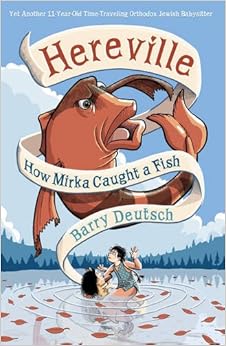
HerevilleAnderman discusses several Jewish-content graphic books in the article. However, many of these are several years old. It is impossible to list off every Jewish graphic novel in such a short piece, but one would hope that the most recent publications would have been included. Hereville : How Mirka Caught a Fish recently won the 2015 Sydney Taylor Award (Older Readers Category), the second such win for its author Barry Deutsch. Although Haaretz is an Israeli publication, no graphic books about Israel (e.g. Not the Israel My Parents Promised MeJerusalem: A Family Portrait; Exit Wounds; Jerusalem: Chronicles from the Holy CityMike’s Place) are discussed.
Though not as troubling as the incompleteness of the research, it’s a bit off-putting that carelessness seems to have resulted in quite a few factual errors. Batman first appeared in Detective Comics #27, not in Batman #1. Iron Man is misspelled as “Ironman.” The story in which Superman captured Stalin and Hitler wasn’t published in a comic book, but in the magazine Look. MAD didn’t start out as a magazine. It was a comic book, but the publisher switched formats to avoid the restrictions of the Comics Code.

To be fair, I don’t know to what extent the shortcomings of the article may be the fault of the editor assigned to the story. However, ultimately, it is the article’s author who gets the byline and is deemed responsible for it. As someone who enjoys reading about the work of Jewish comics professionals and Jewish comic stories, I was looking forward to reading Anderman’s article after Weinstein posted on Facebook about it. I was expecting the article to be more relevant and up-to-date, but instead came away feeling disappointed. Jews have a rich and centuries-old history, but the immediate history of scholarship on comics and Judaism cannot be glossed over so hastily by any reputable news or academic source.

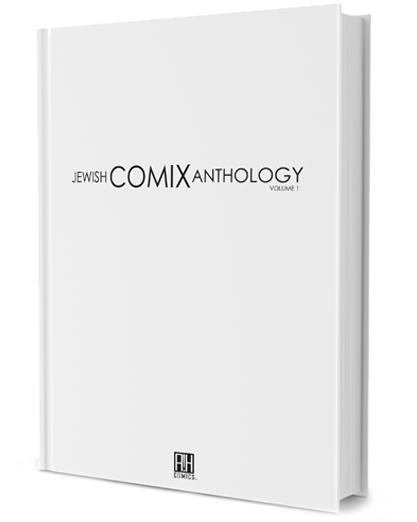
Jewish Comix Anthology*****

Steven M. Bergson is a blogger at http://www.jewishcomics.blogspot.com and has reviewed several graphic books for AJL Reviews (Association of Jewish Libraries). He edited the first volume of  Jewish Comix Anthology (Oakville, ON : AH Comics, 2014).

Sacré & Séquentiel: The New, French-Language “Sacred and Sequential”

Since its launch, Sacred & Sequential has been exclusively an English-language site for the scholarly consideration of religion and comics. Now, with the new year here, S&S is expanding into French-language coverage as well, thanks to the skills of our own Etienne Domingue.
Founding Member A. David Lewis spoke with Etienne about the launch of Sacré & Séquentiel:
A. David Lewis: What makes Sacré & Séquentiel necessary? I mean, why not just shoot the old posts through Google Translate?

Etienne DomingueEtienne Domingue: Whereas automated translation has made great strides in recent years, human languages remain somewhat beyond the grasp of machine intelligence. Errors in automated translation abound: computers are notoriously bad at translating idioms, and they don’t typically have much of an ear for tone or subtext. I suspect this has contributed to comics writers’ exceedingly poor handling of foreign languages — I am frequently shocked by how some anglophone writers assume that word-for-word translation is “good enough,” as though all of syntax and grammar operates in roughly the same way. It does not. Even culturally-sensitive writers make this mistake: G. Willow Wilson’s Air is magnificent, but its French is awful.

I’m sure it’s only a matter of time before human translators — along with all humans, really — are obsolete, but for now this is not the case. I pray that when it is the case, our robot overlords will be merciful.

I believe Sacré & séquentiel is important because francophone interest in American comics exists despite a dearth of francophone literature on the subject.

Continue reading Sacré & Séquentiel: The New, French-Language “Sacred and Sequential”

Transcript: Comix Scholars List Discusses Indian Comics and Manga

imageBased out of the University of Florida’s Comics Studies track within the the Department of English, the Comix-Scholars Discussion List (COMIX-SCHOLARS-L) hosts lively and diverse free, digital conversation between subscribed members invested in comics as a field of study. And sometimes that discussion turns to religion and comics, as it did on Wednesday, November 18th when S&S’s own Beth Davies-Stofka asked the List:

I’m tying up some loose ends on a writing project that relates to scholarship focused on religion in comics.

I have about 250 words that I can devote to the topic of the study of religion in Indian comics. I have Karline McLain’s book, India’s Immortal Comic Books, which I am regarding as a kind of “first” in the field of religious studies.

But I’d like to know if there is work being done on the subject in languages other than English.

Anyone know?

Continue reading Transcript: Comix Scholars List Discusses Indian Comics and Manga

@ the intersection of religion and comics: Graphic Religion