In this lecture I tackle first and foremost the matter of censorship, both in the lecture hall and as it pertains to depictions of Muhammad in modern media. I look at the prophet in animation and then in comics, before moving on to discuss some of the visual functions of the comics medium and connecting visual abstraction as presented by McCloud to identity as defined by religious symbols. After a brief comparison of the idea of bodily representation in Christianity and Islam I close with some thoughts on the human drive as meaning-making, cultural animals and the role of censorship as we create our history.
(The audio for the recording is a little quiet, so turn up your speakers if need be; it begins around 1:30.)
Klassen also collaborated with another S&S founding member, A. David Lewis, on an eight-page comics version of Lewis’s book American Comics, Literary Theory, and Religion: The Superhero Afterlife as “The Superhero Afterlife (Abridged)” for the Sacred Matters web magazine of public scholarship.
Opening page from “The Superhero Afterlife (Abridged)” at Sacred Matters. Words by A. David Lewis, Art by Asher J. Klassen.
Over on The Nomos Journal last year, Paul Robertson delivered a sensational account of the mythic Cyclops through the lens of graphic narrative:
[T]he modern graphic novel arises from, and in turn influences, our modern, Western culture. This culture is globalized, includes values, such as individualism, and contains an audience well versed in postmodern ideas and literature that lend a certain type of irreverent, cheeky, and highly culturally indexed humor. Thus, certain aspects of a given story that are important within the Hebrew Bible, for example, are omitted or given a humorous re-branding explicable to its modern audience. Other elements that may seem non-essential to the original myth, meanwhile, may be kept if they fit certain modern, Western sensibilities. In these ways, the modern graphic novel retains only certain elements of ancient mythology; thus, it maintains the relevance of these stories for a modern audience.
While Robertson overlooks one Cyclops particularly dear to the superhero genre, his analysis is nonetheless impressive and cogent.
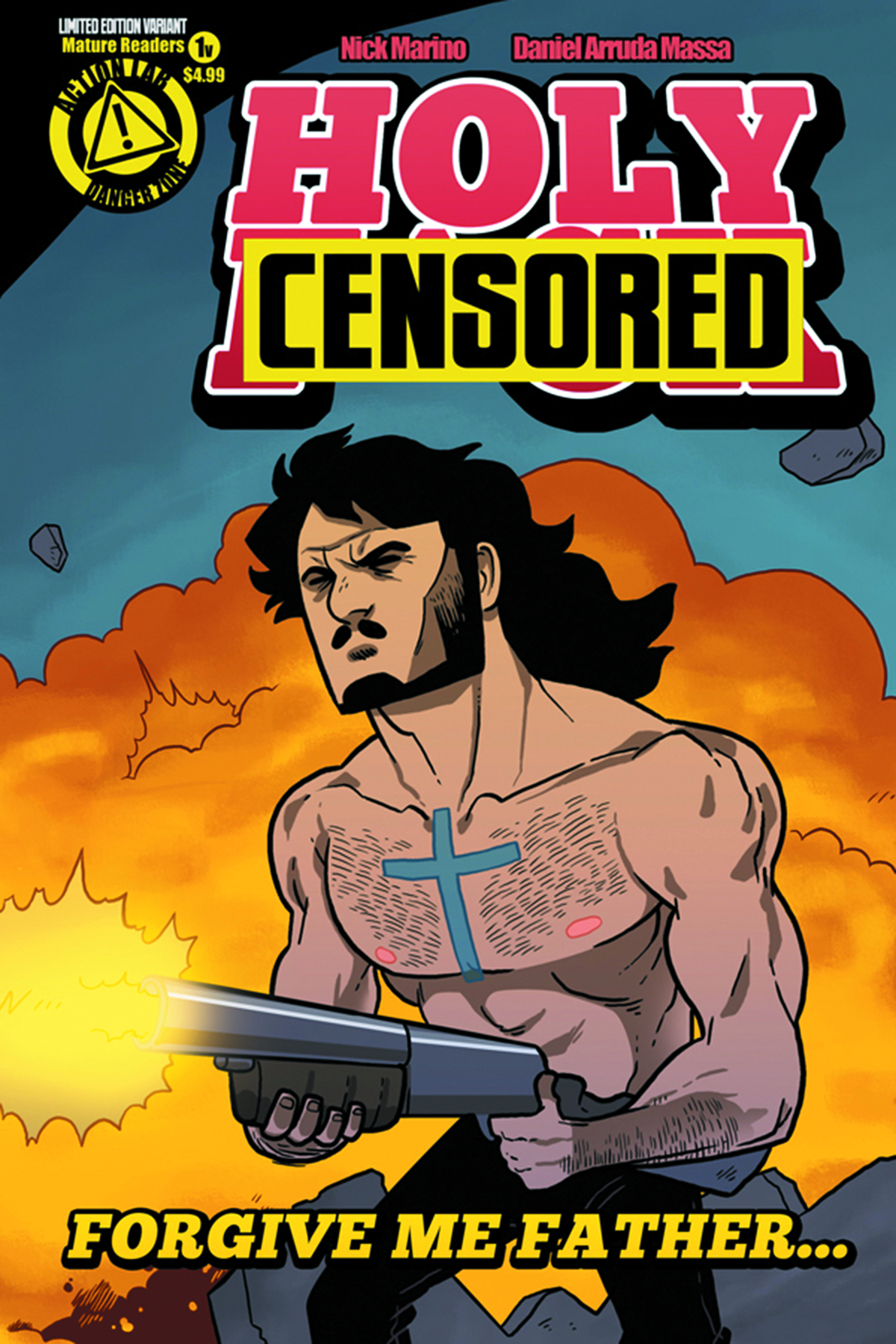
Hitting the stands on Wednesday, January 21, 2015, Nick Marino and Daniel Arruda Massa’s Holy F*ck #1 (Action Lab: Danger Zone) seemed to confirm what it says in Ecclesiastes; there is nothing new under the sun. A heaven-hell team-up? Garth Ennis’ Chronicles of Wormwood gave us that. A hedonistic bad-ass champion of God? Robert Kirkman’s Battle Pope. A heavily armed – Rambo-style – Jesus? Warren Ellis’ Bad World. The one thing that seems novel in Holy F*ck is its alliance of forgotten deities bent on destruction in order to once again get people to believe in them. But this, too, has some precedents, even if not as directly comparable – Marvel Comic’s Council of Godheads immediately comes to mind for the gathering, and the worship-hungry old gods are reminiscent in some ways of the old gods in Neil Gaiman’s American Gods or the alien Goa’uld of Stargate SG-1, for example. And Jesus long ago came off the cross to duke it out with Zeus in Godyssey, because the Greek god was fed up with having lost worshippers to the new monotheism.
Holy F*ck #1 is the first of four issues of what the advance material calls “an edgy satire sprinkled with action and adventure.” The plot so far is pretty straight-forward: a nun, as yet unnamed, seeks out – literally finds – Jesus so he can help her save the world from Polydynamis, Inc., a multinational company bent on worldwide destruction. Led by Zeus and Isis, and with a board consisting of a handful of other old, no longer worshipped gods, the group wants to plunge the world into chaos so that people will pray for help; by responding to those prayers, the thinking goes, the Polydynamis board will once again be worshipped by humanity. The issue ends with Jesus and the nun traveling to New Jersey (complete with parodied Jersey Shore beach bums) to enlist some backup from hell.
In the wake of the Paris attacks, the mediasphere began to talk — as it always does — and much of it has been talking in circles, or at cross-purposes. Tragedy causes the exponential proliferation of polemics, creating an overheated environment in which nuance tends to suffocate.
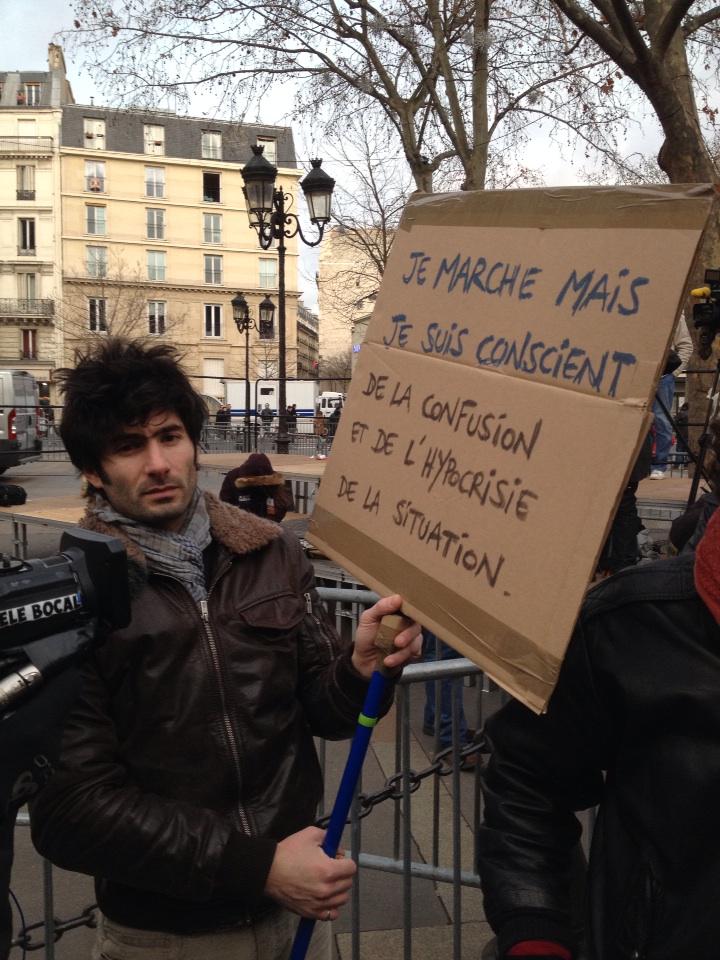
Translation: “I walk [figuratively: I protest] but I am aware of the confusion and the hypocrisy of the situation.” From Twitter user @EllenKnickmeyer
Some time after the initial shock of the news, I was made extremely uncomfortable by certain elements of the popular response to the attacks. I was most of all taken aback by the unprecedented proportions of the outcry: whereas I trust it goes without saying that the slaughter of innocents deserves universal condemnation, I am still unclear as to how these deaths are more worthy of worldwide lamentation than the murder of the Jewish children of Toulouse, to say nothing of the everyday abominations suffered upon the developing world. I appreciate this opinion is not a particularly original one, but it was the first to come to my mind once the visceral sense of dread abated.
My discomfort only grew as I became aware of the idiom which arose spontaneously out of a laudable sense of sympathy for the victims of the attacks. While I understand that the meaning of an expression is its use — and that usage is determined more or less entirely by circumstance — I found myself in the awkward position of agreeing with David Brooks, who said in The Times that “[…] it is inaccurate for most of us to claim, Je Suis Charlie Hebdo […]. Most of us don’t actually engage in the sort of deliberately offensive humor that newspaper specializes in.”
I have only passing familiarity with Charlie Hebdo — passing, that is, in the sense that I have only ever “passed” every opportunity to read it, finding the headlines and the covers much too crass. No one ever said that Charlie is for everyone: Le Devoir’s Stéphane Baillargeon aptly calls the newspaper “moins satirique que vitriolique.” [EDITOR’S NOTE: That translates, roughly, as “less satirical than abusive.”] In full, honest recognition of Charlie’s style and function, it should be possible, without seeming contrarian or disrespectful, to take exception to “Je suis Charlie” on the reasonable grounds that it may be problematic in its implications. On Twitter (where sarcasm is never in short supply) one commentator expressed relief that Éric Zemmour was not amongst the victims so that he should not have to identify with a figure who is even more controversial than Charlie Hebdo.
The immediate aftermath of a catastrophe is hardly the appropriate time for hair-splitting debates over the intentional fallacy, but it is hopefully not entirely out of place to observe that caricature does not affect the powerful and the disenfranchised in the same manner. As Teju Cole wrote in The New Yorker: “The West is a variegated space, in which both freedom of thought and tightly regulated speech exist, and in which disavowals of deadly violence happen at the same time as clandestine torture. […] It is not always easy to see the difference between a certain witty dissent from religion and a bullyingly racist agenda, but it is necessary to try.”
I would never suggest that freedom of speech is not a more fundamental principle than the respect of institutions which any misguided interpreters of Islam might seek to appropriate for themselves through fear and strength of arms. On the other hand, true freedom is complex, and I worry that this incident will be instrumentalized in the great xenophobic tradition of “the clash of civilizations,” a base rhetoric of essentialized ethnic designations which has been making a comeback in the writings of popular intellectuals such as Houellebecq and Zemmour.
There is not much else which my experience and expertise allow me to say. I might add that I find the question of whether or not images of the Prophet are forbidden in Islam to be somewhat beside the point; it seems to me it should be enough to reflect that the issue of representation is superlatively fraught, though I suppose it is not my (nor anyone’s?) place to decide what should or should not be part of the conversation.