Comics and Religious Education in “Studies in Comics”

The latest issue of the Studies in Comics journal from UK-based publisher Intellect features an article by Rae Hancock entitled, “More Credo, Less Capes: Why and How We Should Use Comics in the Religious Education Classroom.” The abstract, copied below, promises for lively debate among related scholars; look for responses and further coverage to come.

Research into religion and comics is flourishing and has called attention to the various ways in which religion features across the medium. However, consideration has not yet been given to the role of comics with religious dimensions in the Religious Education (RE) classroom despite significant attention having been paid to their use in schools through subjects such as English. Nonetheless comics are being used outside the classroom to communicate religious ideas and references to the medium are beginning to appear on exam specifications with the intention that candidates engage with religious representations in the media and popular culture. As such, seeking ways to bring comics with religious dimensions into a subject that concerns itself with ‘learning about’ and ‘learning from’ religion allows comic scholarship the potential to be genuinely impactful. A compulsory subject without a strict, prescriptive curriculum, RE is at once accused of indoctrination and called upon to be at the forefront of the battle against extremism. This article presents an overview of the contemporary RE climate in English state secondary schools, then builds on the rationale of why we should use more comics in RE and suggests approaches to using selected comics. The examples considered are necessarily broader than those typically discussed by scholars as they are chosen based on their pedagogical appropriateness. Consideration is given to the theoretical and practical challenges facing the rationale and it is concluded that in order to continue to explore, refine and validate the usefulness of comics in RE the body of sources used needs to expand and become representative in its breadth. Further, continuing to examine why and how we should use comics in the classroom has the potential to deepen and improve the quality of RE and provide comics scholarship opportunities to examine practical applications of the medium.

Hancock, Rae. “More Credo, Less Capes: Why and How We Should Use Comics in the Religious Education Classroom.” Studies in Comics 6.1 (July 2015): 25-41. Print.

Religious Revivals and the Great Awakening of Religion & Comics

[Part Two of “What Makes a Scholar’s Pull-List?”]

Panel from _Manifest Destiny_, art by Matthew Roberts
Panel from _Manifest Destiny_ by Chris Dingess with art by Matthew Roberts

American historians sometimes call the waves of religious fervor in the 18th and 19th century our country’s “Great Awakening.” It is a powerful image–convinced that God’s spirit was calling Christians to renew their commitments–Americans flocked to open-air revivals to hear fiery sermons by orators like George Whitefield. Among the innovations of this era was what would become evangelicalism, that variety of Christianity that emphasized the individual, emotional “born again” experience of admitting one’s sinful nature and accepting Jesus’ offer of redemption.

Why this historical introduction? I have tried to consider various explanations for how my assortment of monthly comics came to be.  Are my subscriptions simply the products of obscure personal quirks? Am I distracted by certain styles of art or attracted to certain writers? No matter how I tried to explain why I had certain comics on my list to be set aside monthly when they arrive, I found that the list defied me.

Continue reading Religious Revivals and the Great Awakening of Religion & Comics

Review of HOLY F*CKED #1: “Provocation for Provocation’s Sake” [Redux]

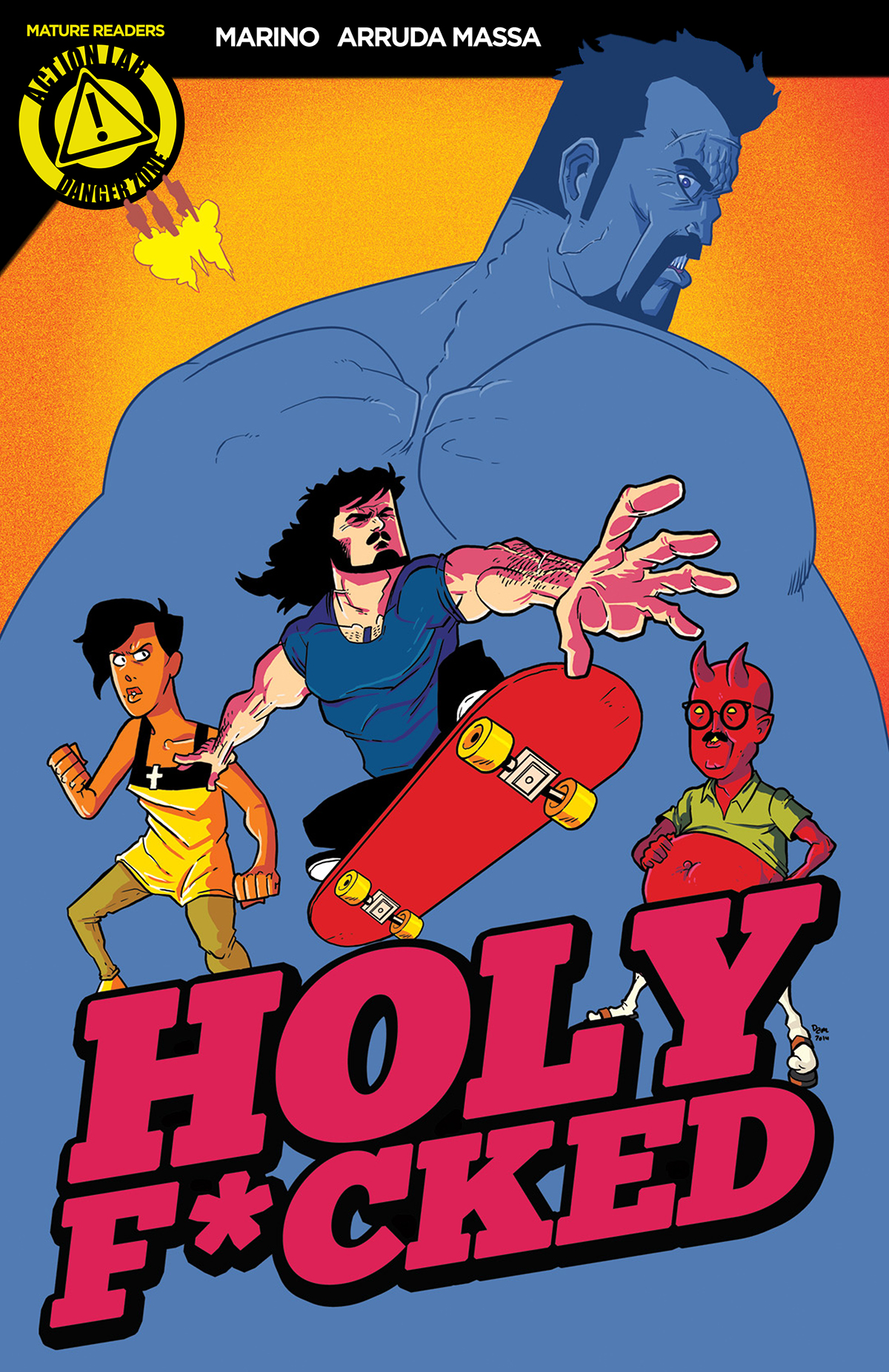
HOLY F*CKED #1Earlier this year, I reviewed Nick Marino and Daniel Arruda Massa’s miniseries Holy F*ck. Throughout the run, I consistently found the series to be missing that certain something. The artwork was consistent and the writing delivered several gags that were independently funny without fully meshing with each other. My final verdict was that the series as a whole seemed directionless, almost scattershot. But I also kept wanting more. I find myself in that same situation as fall starts creeping in.

Last week, Marino and Arruda Massa returned with the first issue of Holy F*cked. With that, we are cast once more into the lives of Jesus, Satan, and the nun Maria, who have all found happiness in Los Angeles. Jesus has gotten real big into skateboarding (I am certain that although this hasn’t really been explained, it will eventually play a big role). Jesus and Satan are living together, and pretty early on we find out that the devil is pregnant. For her part, Maria works in a soup kitchen, regaling the homeless with old war stories.

Of course, we know that their bliss can’t last. Anansi, the African spirit that most often takes the form of a spider and is connected with knowledge, overhears the news and reports it to Hercules. Hercules is thirsting for revenge: after Jesus and his cohorts defeated Zeus, Mount Olympus deteriorated from a prosperous, “grand utopian metropolis” to a wasteland. And so, out of rage and jealousy that the man who took away his family is about to start his own, Hercules resolves to murder Jesus Christ. Setting his plan in motion, he goes to Earth and, disguised as Thanatos Kostas (a play on the Greek personification of death and a word meaning roughly “constant”), a newcomer to town who is passionate about charity work, he infiltrates the soup kitchen.

That, more or less, is the story.

Continue reading Review of HOLY F*CKED #1: “Provocation for Provocation’s Sake” [Redux]

Graphic novel “Our Friend Satan” Meets Funding Goal

Last week, Imagomedia succeeded in their campaign to raise funds for their Our Friend Satan graphic novel, the first 18 pages of which can be viewed for free on their website.

The book, also planned as a short, live-action film, features Satan in the midst of “a midlife crisis.” In turn, he moves to sue the Papacy for defamation of character.

Fans of The Chronicles of Wormwood, Battle Pope, or Holy F*ck will want to check this out in May of next year.


New Philadelphia Museum of Jewish Art Exhibition on Comics

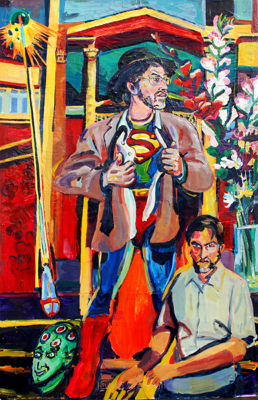
“House of El” by Joel Silverstein

Beginning Tuesday, October 15th, the Philadelphia Museum of Jewish Art (along with the Jewish Art Salon) will be featuring a new exhibit: JOMIX – Jewish Comics: Art & Derivation. The show promises a showcase “of cutting-edge creators, reinvestigating traditional genres like superhero, political satire, romance, horror, science fiction and confessionals through a Jewish lens.”

Guest speakers are scheduled to include Joel Silverstein, Richard McBee, and Aimee Rubensteen, Exhibit Curators from the Jewish Art Salon. Introductions will be provided by Yona Verwer, President of the Jewish Art Salon, and Participating Artists include

Shay Charka, Howard Chaykin, Leela Corman, Jessica Deutsch, Aliza Donath, Dorit Jordan Dotan, Josh Edelglass, Zev Engelmayer, Liana Finck, Stuart Immonen, Miriam Katin, Scott Koblish, Michael Korosty, Yonah Lavery, Miriam Libicki, Sarah Lightman, Rutu Modan, Archie Rand, Ariel Schrag, Liat Shalom, Dov Smiley, Joshua Stulman, Arthur Szyk, Deborah Ugoretz, Eli Valley, Julian Voloj, JT Waldman, David Wander, Al Wiesner, Jack Kirby, Joel Silverstein, and Ephraim Wuensch.

A catalogue for the exhibit will be available in September.

@ the intersection of religion and comics: Graphic Religion