(The following article by Ardo Omer first appeared at Panels.net on 7/17/2015. It is presented here with her permission.)
Eid Mubarak, readers! For most Muslims, today marks the end of Ramadan – an Islamic month – which is roughly 30 days of fasting, and Muslims are expected to not consume food or drink from sunrise to sunset. Eid al-Fitr is a celebration of the end of Ramadan, and marks the start of a new Islamic month: Shawwal. I thought it would be great to celebrate alongside some fellow Muslims in comics to mark the occassion on Panels. I hope you all join in on the festivities, and if you happen to see a Muslim today, greet them with Eid Mubarak. Now onwards!
Qahera: The Superhero
Qahera is a webcomic about a Muslim female superhero who fights misogyny, and Islamophobia. She’s created by a Muslim Egyptian woman, and it’s a great read.
Shahara Hasan is a character in a limited Vertigo series called Bodies by Si Spenser, Meghan Hetrick, Dean Ormston, Tula Lotay, and Phil Winslade. She’s a Detective Sergeant who’s one of four detectives across four time periods trying to solve a murder. She tries to balance her faith, her duty, being a Muslim, and identifying as British which sounds like an interesting read. It’s a comic I definitely want to check out.
Last Friday at the San Diego Comic Con International, the winners of the 2015 Eisner Awards were announced. We at Sacred & Sequential would like to offer our congratulations to editor Sarah Lightman who took home the Eisner Award for “Best Scholarly/Academic Work” with her book Graphic Details: Jewish Women’s Confessional Comics in Essays and Interviews, published by McFarland. It’s a treat to see academics at the intersection of comics and religion take home such a prestigious industry award for their scholarship. We look forward to following such achievements as scholars delve ever further into the worlds of Jewish culture, of autobiographical comics, and of the women who make them.
On behalf of Sacred & Sequential, we wish the contributors to Graphic Details all the best and, again: Congratulations!
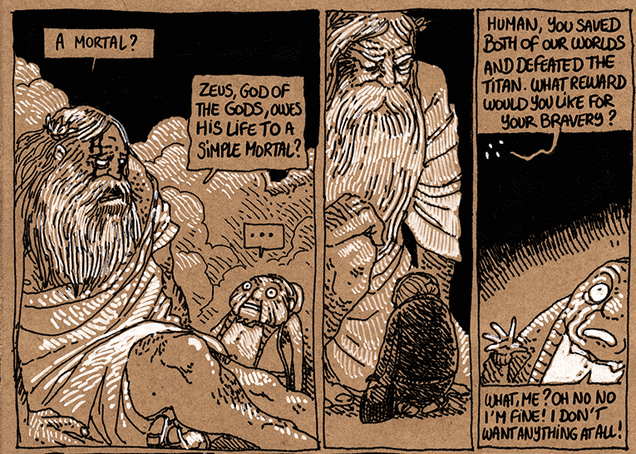
Earlier this year, French cartoonist Boulet (aka Gilles Roussel) focused his annual 24-hour comic on the Greco-Roman gods, specifically Zeus and his near-defeat at the hands of renewed Titans. However, mortal woman Genevieve Menard was there to save the day, and thus The Gaeneviad began:
Panels from The Gaeneviad by Boulet, Courtesy of io9
In as much as there it is mildly NSFW with male nudity, The Gaeneviad is a wonderful, humanizing romp through the Olympian gods’ confusion over humans. In addition to their theology, there’s a philosophy behind Zeus’s favor of Genevieve that makes the story insightful while also amusing:
“In our celestial patheon made of blood, fire and steel, we could really use an old lady helps wounded birds.”
(NOTE: The following announcement can be found in full here.)
Sacred Texts and Comics: Religion, Faith, and Graphic Narratives Edited by Ken Koltun-Fromm and Assaf Gamzou Proposed volume for the “Critical Approaches to Comics Artists” series, University Press of Mississippi In addition: Symposium on “Sacred Texts and Comics” at Haverford College, May 5th and 6th, 2016 (workshops for contributors to this proposed volume are included)
The last decade has produced critical and expressive studies in sacred canonical texts and comics. Witness, for example, the artistic works from R. Crumb’s The Book of Genesis (2009) and JT Waldman’s Megillat Esther (2005), as well as scholarly publications from Karline McLain’s India’s Immortal Comic Books (2009), A. David Lewis’s edited volume Graven Images: Religion in Comic Books & Graphic Novels (2010), and Samantha Baskind’s and Ranen Omer-Sherman’s editorial work for The Jewish Graphic Novel: Critical Approaches (2010).
Sacred Texts and Comics: Religion, Faith, and Graphic Narratives is a proposed volume for the “Critical Approaches to Comics Artists” series at the University Press of Mississippi that builds upon, but also beyond, Western or “major” religious traditions to develop a broader landscape of religious graphic mediums. We encourage submissions that engage Islamic, Jewish, Christian, Hindu, Buddhist, Native American, African Diaspora traditions, or other religious communities from a variety of disciplinary or cross-disciplinary perspectives. Such critical approaches may include studies in religion, literature, theology, art history, culture, anthropology, political science, or other disciplines that work with the multi-dimensional features of graphic narratives.
Topics may include, but are not limited to:
Depictions of the sacred in comics.
The place of historical exegesis and critical, religious interpretation in graphic narratives.
Comics as a form and method of interpretation.
The ways in which the graphic, formal features engage notions of the sacred.
The modes by which graphic narratives represent the sacred or conceptions of religion.
The ways in which religious identity and belief are represented and explored in graphic mediums.
The multiple ways that visual culture informs religious practice.
Please send a 500-1000 word abstract, CV, and contact information to Ken Koltun-Fromm (kkoltunf@haverford.edu) and Assaf Gamzou (assaf@cartoon.org.il) by August 21, 2015.
Haverford College will host a symposium on “Sacred Texts and Comics” on May 5th and 6th, 2016 that will include workshops for contributors to this proposed volume. Please indicate your interest in and availability to participate in the symposium (all expenses will be paid, including a small stipend).
In a piece last year for Nomos Journal, I explored how the ancient Greek myth of the Cyclops compared in Homer’s Odyssey to the modern graphic novel The Encyclopedia of Early Earth by Isabel Greenberg (December 2013). Homer’s account became the definitive text in the West for the mythical concept as well as the hypothetical, physical characteristics of this creature. As I argued in that piece, however, whenever a myth gets re-appropriated and re-produced by a different culture, it is subject to modification. While some see a loss of the original “essence” of a myth, others view this change as a positive thing insofar as it is by this modification that myth remains dynamic and relevant for a different people and time.
The graphic novel is a prime example of how ancient stories remain relevant for a modern audience. The explosion in graphic novel production in recent years has given us plenty of data for the types of modifications that occur in these ancient myths. By investigating which types of modifications occur, we can find out what particular cultures value, and what they do not. Elements of ancient myth that conform to modern values will be retained or strengthened, in other words, while elements of ancient myth that are irrelevant to modern culture and sensibility will be minimized or removed. With an attention to what is retained/removed and highlighted/diminished between the two permutations of a given myth, we can identify more concretely different cultural values.
It was with this understanding that I compared Homer’s Cyclops Polyphemus to Greenberg’s graphic novel depiction of the Cyclops in her own imaginative re-telling of parts of the The Odyssey. It turned out that, save for some basic characteristics in form (large, monstrous, and one eye) and landscape (seemingly isolated and generally undeveloped), the episodes were hugely different. There was no dialogue in Greenberg, no contrast between a civilized, social Greek (Odysseus) and an uncivilized or minimally civilized solitary brute (Polyphemus).
The episode in Homer revolved around the concept of hospitality, a socially constructed obligation that Polyphemus flouts and thereby rejects society. Homer also focused on the combination of teamwork and cunning in Odysseus’s escape, two characteristics that defined what it meant to be a citizen in Greek democratic society. Greenberg’s hero uses no teamwork, no cunning, and escapes purely through humorous, dumb luck as a bird poops in the Cyclops’s eye, thereby giving the protagonist time to escape. Greenberg’s hero is a ‘better lucky than good’ protagonist on an individual quest for romantic love, a distinctly modern concept.
Cyclops of ASTONISHING X-MEN
Compared to Homer’s Odysseus, Greenberg’s hero – with a romantic goal, lucky escape, lack of crewmates, and lack of socially constructed value such as hospitality – fully reflects modern, Western culture’s value of individualistic identity over and against Homeric Greece’s socially constructed identity.
But there is another prominent Cyclops in the modern graphic novel, the Scott Summers of Marvel Comics’s X-Men fame. If my above argument is correct, that Greek concepts of socially structured identity become effaced when translated into modern culture, we should expect that a comparison of Homer’s Polyphemus and Marvel’s Cyclops yields the same result: some core similarities in terms of physical form, perhaps, but large-scale differences in interactions and identity. Continue reading Cyclops in Homeric Myth and Marvel Comics→
@ the intersection of religion and comics: Graphic Religion